
Dirt makes floors more slippery by reducing the friction between your footwear and the floor surface. When contaminants like dust, grease, or moisture build up on a floor, they act as a lubricant between your shoe and the ground, lowering the grip that keeps you upright. This applies to virtually every type of flooring, from smooth concrete to textured tile. The sections below break down exactly how this happens, which contaminants are most dangerous, and what you can do to keep floors safe.
Why do floors become more slippery when dirty?
Floors become slippery when dirt disrupts the direct contact between a shoe sole and the floor surface. Friction is what keeps you from sliding, and it depends on two surfaces gripping each other directly. When a layer of contamination sits between those surfaces, it reduces that grip, sometimes dramatically. Even a thin film of grease or a light dusting of dry powder can cut friction enough to cause a fall.
The physics behind this is straightforward. Clean, dry surfaces have high friction coefficients, meaning they resist sliding. Introduce a contaminant, and that coefficient drops. Wet or oily substances are especially effective at reducing friction because they fill in the microscopic texture of a floor, smoothing out the very features that provide grip. Dry contaminants like sawdust or flour behave similarly, acting almost like ball bearings underfoot.
This is why floor safety is not just about choosing the right flooring material. Even the best non-slip surface can become a hazard if it is not kept clean.
What types of dirt pose the greatest slip risk?
Not all contamination is equally dangerous. Oily and greasy substances pose the greatest slip risk because they are highly effective at reducing friction, and they spread easily underfoot. Water-based contaminants come second, especially on smooth surfaces. Dry loose particles like dust, flour, or granular debris also create serious hazards, particularly in industrial and food production environments.
Here is a practical breakdown of the most common high-risk contaminants:
- Oils and grease: Common in kitchens, workshops, and manufacturing floors. These create a very low-friction film that is difficult to see and easy to step into.
- Water and liquid spills: Particularly dangerous on smooth tile, polished concrete, or sealed wood. Even a small puddle can cause a serious fall.
- Dust and fine particles: Found in warehouses, construction sites, and agricultural settings. Dry particles reduce surface contact in the same way wet substances do.
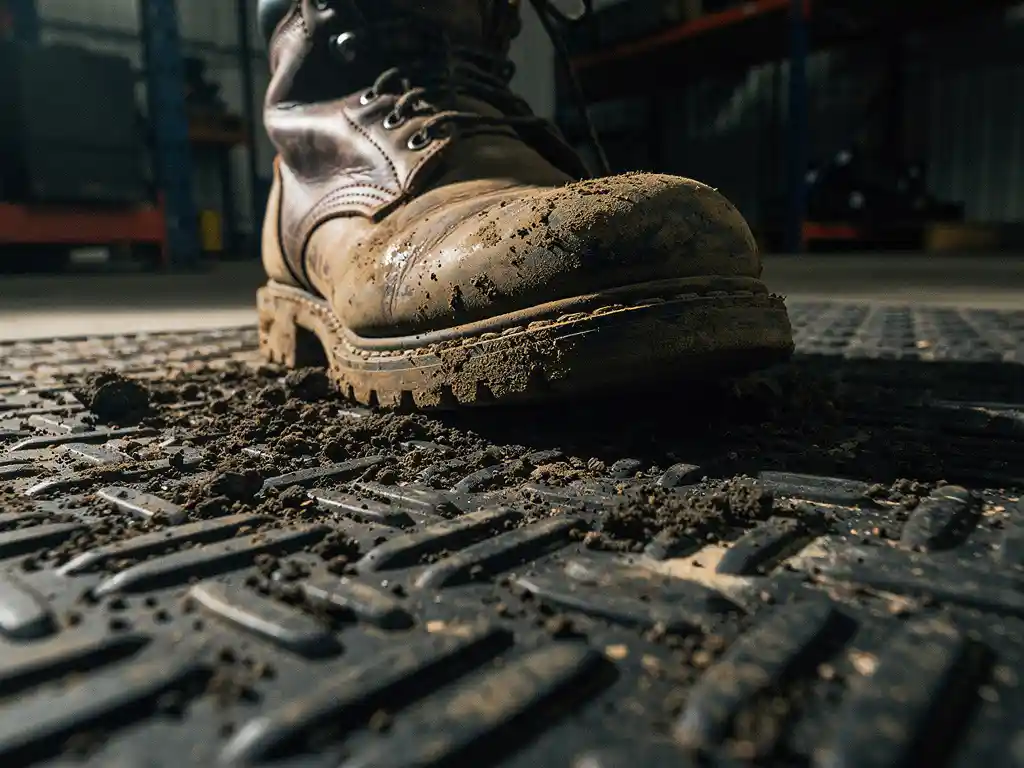
- Mud and organic debris: Tracked in from outside, especially in agricultural or outdoor-adjacent environments. These combine moisture with loose particles, making them doubly hazardous.
- Food residue: Common in commercial kitchens and food processing areas. Fats, sugars, and starches all reduce grip significantly.
The severity of the slip risk also depends on how quickly the contamination is noticed and addressed. A spill that sits on a busy factory floor for even a few minutes can lead to a serious incident.
How does surface texture affect grip when contaminated?
Surface texture plays a big role in how much grip a floor retains when contaminated, but it is not a simple case of “more texture equals safer.” Coarser, more textured surfaces generally maintain better grip under light contamination because the peaks of the texture still make contact with shoe soles even when the valleys are filled with dirt or liquid. However, heavily textured surfaces can also trap contamination, making them harder to clean and potentially hiding hazards.
Smooth surfaces lose grip almost immediately when wet or oily because there is no texture to maintain contact points. This is why polished concrete and glazed tile are among the most hazardous floor types in contaminated environments.
Open-pattern textures, like those found on many rubber mats, offer a practical middle ground. The raised surface pattern maintains contact with shoe soles while channels between the raised areas allow liquids and debris to drain away rather than pool on the surface. This design actively manages contamination rather than simply hoping it does not cause a problem.
Does rubber matting stay slip-resistant in dirty conditions?
Rubber matting generally maintains better slip resistance in dirty conditions than hard flooring surfaces, but it is not immune to contamination. The key advantage of rubber is that its natural grip and surface texture work together to maintain friction even when some contamination is present. The material itself has a higher coefficient of friction than most hard floors, which gives it a built-in safety margin.
Textured rubber mats with raised patterns or drainage channels are particularly effective in wet or contaminated environments. The texture keeps shoe contact points elevated above any liquid or debris on the surface, while the channels direct contamination away from the walking area. This is why rubber matting is widely used in kitchens, workshops, and industrial settings where floor hazards are a daily reality.
That said, rubber mats can still become slippery if they are coated in heavy grease or oil, or if they are not cleaned regularly. A rubber mat that has accumulated a thick layer of oil or compacted debris will lose much of its slip-resistant advantage. Regular cleaning is still a requirement, even with high-performance matting.
How often should mats be cleaned to maintain slip resistance?
Mats should be cleaned as often as the environment demands, not on a fixed calendar schedule. In high-contamination environments like commercial kitchens or manufacturing floors, daily cleaning is often necessary. In lower-traffic or cleaner environments, weekly cleaning may be sufficient. The practical rule is simple: if you can see contamination building up, clean the mat before it becomes a slip hazard.
For rubber mats specifically, cleaning is straightforward. Rubber is non-porous, so it does not absorb liquids or retain bacteria the way porous materials can. A mild detergent and water are typically all you need. For heavy contamination like grease buildup, a degreasing cleaner applied with a stiff brush will restore the surface effectively.
A few practical guidelines for mat maintenance:
- Inspect mats at the start and end of each shift in high-risk environments
- Address spills immediately rather than waiting for a scheduled cleaning
- Lift mats periodically to clean the floor beneath, where moisture and debris can accumulate
- Check mat edges and surfaces for wear that might reduce grip over time
- Replace mats that show significant surface degradation, as worn surfaces provide less friction
A floor safety inspection routine that includes mat condition checks is one of the most effective ways to stay ahead of slip hazards before they cause an incident.
What are the safety risks of ignoring floor contamination?
Ignoring floor contamination is one of the most direct causes of slip and fall incidents in workplaces and commercial spaces. Slip and fall accidents are among the most common causes of workplace injuries, leading to lost work time, medical costs, and in serious cases, long-term disability. Beyond the human cost, businesses also face regulatory consequences and liability exposure when floor hazards are left unaddressed.
The risks compound quickly in environments where contamination is a regular occurrence. A floor that is consistently oily or wet without proper matting or cleaning protocols in place becomes a predictable hazard, not just an occasional one. Workers and visitors adapt to the environment over time, which can actually increase risk as familiarity breeds complacency.
There are also secondary risks beyond slipping. Contaminated floors can damage equipment, attract pests in food environments, and create hygiene problems that compound over time. Addressing floor contamination is therefore not only about slip and fall prevention, it is about maintaining a safe and functional environment overall.
Taking floor safety seriously means combining the right flooring and matting with consistent cleaning habits and regular floor safety inspections. At LRP Matting, we make rubber mats designed to hold their grip in exactly the kinds of dirty, demanding conditions described above. If you work in an environment where floor contamination is a daily reality, exploring industrial matting solutions is a practical first step toward reducing your slip risk.
Frequently Asked Questions
How do I know if my current flooring is at a dangerously low level of slip resistance?
The most reliable way to assess slip resistance is to use a slip meter or pendulum test device, which measures a floor’s coefficient of friction (CoF) against recognised safety thresholds. A CoF below 0.4 is generally considered a slip hazard. If professional testing is not immediately available, a practical first step is to observe whether footwear loses grip during normal walking, especially when the floor is lightly wet or dusty — if it does, the surface needs attention. Combining a professional assessment with a visual contamination audit will give you a clear picture of where your greatest risks lie.
What is the best way to get started with a floor safety plan if I have never had one before?
Start by walking your facility and identifying every area where contamination regularly occurs — kitchens, entry points, production lines, and anywhere liquids or debris are handled. For each zone, note the floor type, the most common contaminants, and how quickly they are currently being addressed. From there, prioritise the highest-risk areas first by installing appropriate matting, establishing a cleaning schedule, and assigning clear responsibility for inspections. Even a simple one-page checklist distributed to staff can dramatically reduce incidents by making floor safety a visible, routine part of operations.
Can anti-slip coatings or treatments be used instead of matting, and how do they compare?
Anti-slip coatings and chemical etching treatments can improve the grip of smooth hard floors by increasing surface texture, and they are a useful option in areas where matting is impractical — such as ramps or wet room floors. However, they tend to degrade over time with foot traffic and cleaning, requiring reapplication, and they do not manage contamination the way a well-designed rubber mat does. Matting with drainage channels actively moves liquid and debris away from the walking surface, whereas a coated floor still relies on the contamination being cleaned away promptly. In high-contamination environments, matting typically offers more consistent, long-term protection.
Are there specific footwear recommendations that work alongside good floor maintenance to reduce slip risk?
Yes — footwear plays a significant role in slip prevention and works in combination with, not instead of, good floor management. Shoes with soft rubber outsoles and a tread pattern designed to channel liquid away from the contact point provide meaningfully better grip than flat or hard-soled footwear on contaminated surfaces. In high-risk environments like commercial kitchens or industrial facilities, slip-resistant safety footwear meeting recognised standards (such as EN ISO 20345 in Europe) should be treated as a baseline requirement. The safest outcome comes from pairing appropriate footwear with clean, well-maintained flooring and effective matting — no single measure is sufficient on its own.
What are the most common mistakes businesses make when trying to manage slip hazards?
The most common mistake is treating floor safety as a reactive issue — only acting after an incident has occurred rather than building prevention into daily routines. Another frequent error is relying on a single control measure, such as installing matting, without also maintaining a cleaning schedule or training staff to report spills immediately. Businesses also often overlook the floor beneath their mats, where moisture and debris accumulate and can cause mats to shift or harbour bacteria. Finally, mats are sometimes kept in service long past the point where their surface has worn smooth and lost meaningful grip, which creates a false sense of security.
How does temperature or seasonal change affect floor slip risk, and should my approach change accordingly?
Seasonal changes introduce contamination patterns that many facilities do not fully account for. In wet or cold weather, staff and visitors track in significantly more moisture, mud, and road grit, dramatically increasing slip risk at entry points and transition areas. In summer, increased foot traffic and open doors or windows can bring in more dust and organic debris. Adjusting your approach seasonally — for example, adding extra entrance matting in winter, increasing inspection frequency during peak contamination periods, and reviewing cleaning product choices for cold-weather conditions — ensures your floor safety measures stay matched to real-world conditions rather than a fixed annual routine.
When should a rubber mat be replaced rather than just cleaned?
A rubber mat should be replaced when its surface texture has worn noticeably smooth, when the material has hardened or cracked, or when it no longer lies flat and begins to curl at the edges or buckle in the middle — all of which create trip hazards in addition to reduced grip. If cleaning no longer restores the surface to a visibly clean, textured finish, that is also a strong indicator that the mat has reached the end of its effective service life. As a general rule, a mat that you would hesitate to walk across in wet conditions is a mat that needs replacing, not just cleaning.
Related Articles
- What role does drainage play in animal welfare?
- What should be included in a sports surface safety inspection?
- What makes a sports surface safe?
- What should be included in a floor safety checklist?
- How do professional stables manage bedding across a large number of stalls?
- How do large equestrian facilities keep stall maintenance costs down?
- What is the difference between interlocking and straight edge stall mats?
- What is the best way to protect a warehouse floor during construction?
- How does stall flooring affect a horse's joint health?
- What flooring works best in an outdoor or covered sports venue?