

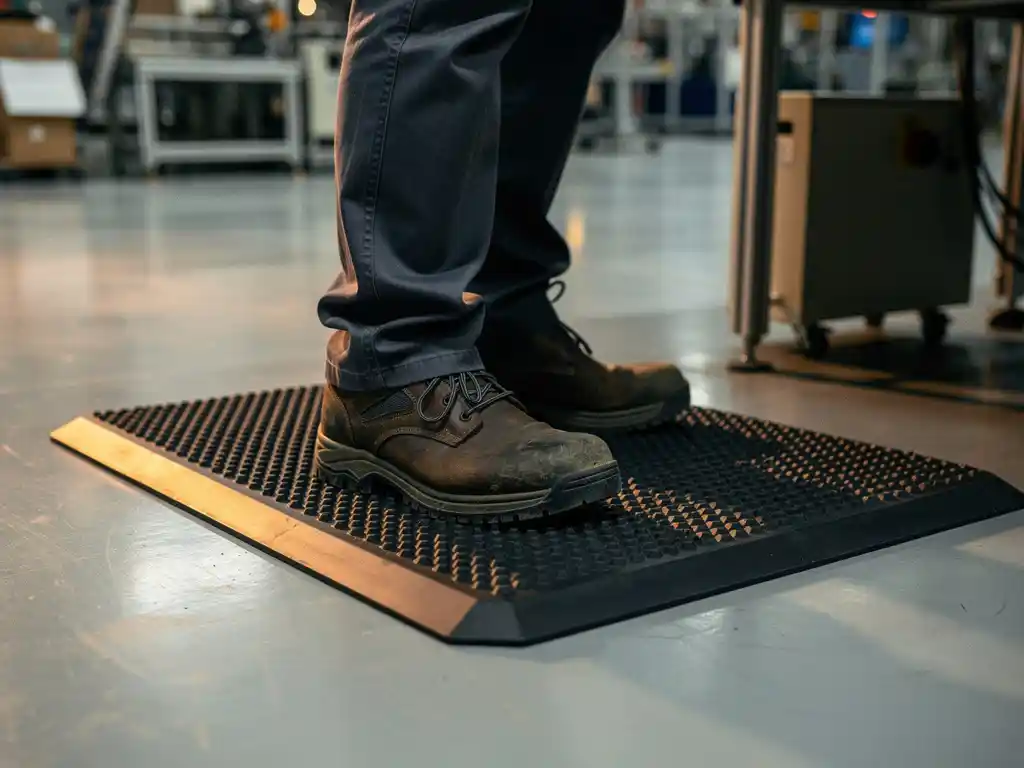
Workplace surfaces have a direct impact on employee well-being. Hard, unforgiving floors increase physical strain on the body, raise the risk of slips and falls, and contribute to fatigue that builds up over a full shift. This applies to almost any job that involves standing, walking, or working on your feet for extended periods. Below, we answer the most common questions about how flooring affects your team’s health, safety, and performance.
How do hard floors cause physical strain at work?
Hard floors cause physical strain by forcing your muscles, joints, and connective tissue to absorb constant impact without any cushioning. When you stand on concrete, tile, or other rigid surfaces for hours at a time, your body has nowhere to distribute that load. Over time, this leads to fatigue, discomfort, and longer-term musculoskeletal problems in the feet, knees, hips, and lower back.
The issue is not just about comfort. Standing on hard surfaces activates continuous low-level tension in the muscles of the legs and lower back as they work to keep you upright and stable. Unlike sitting or walking, prolonged standing on an unforgiving surface gives those muscles no recovery phase. The result is cumulative: mild discomfort in the morning can become significant pain by the end of a shift.
Workers in manufacturing, retail, food service, and healthcare are particularly exposed to this kind of strain. In environments where staff spend six to ten hours on their feet, the surface underfoot is not a minor detail. It is a meaningful factor in how people feel at the end of the day and how well they function over weeks and months.
What is anti-fatigue matting and how does it work?
Anti-fatigue matting is a type of flooring designed to reduce the physical strain of prolonged standing. It works by providing a slightly compressible surface that encourages subtle, continuous movement in the muscles of the legs and feet. This micro-movement improves circulation, reduces static muscle tension, and lowers the overall stress on joints compared to standing on a hard floor.
The mechanism is straightforward. When you stand on a firm but slightly yielding surface, your body makes small, constant adjustments to maintain balance. These adjustments keep blood flowing more actively through the lower limbs and prevent the kind of static loading that leads to fatigue and discomfort on rigid floors.
Not all anti-fatigue mats are built the same. The material, thickness, and density all affect how well a mat performs. Rubber is widely regarded as one of the most effective materials for this purpose because it offers the right balance of give and support. It holds its shape under heavy use, does not compress permanently over time, and performs consistently across a range of temperatures and conditions.
Which work environments benefit most from rubber matting?
Rubber matting is most beneficial in environments where workers stand for long periods, where floors are exposed to liquids or debris, or where heavy equipment or foot traffic creates significant wear. This includes manufacturing floors, commercial kitchens, gyms, workshops, warehouses, and assembly lines. Any space that combines prolonged standing with physical or environmental demands is a strong candidate.
In industrial settings, rubber mats serve multiple roles at once. They cushion workers against fatigue, protect the floor surface from damage, and provide traction in areas where spills or wet conditions are common. In commercial environments like retail stores or reception areas, they reduce the toll of long shifts on staff while also improving the appearance and feel of the space.
Agricultural environments are another area where rubber flooring makes a measurable difference, not just for workers but also for animals. Dairy and beef facilities, for example, use rubber mats to improve footing and comfort for livestock, which directly affects their health and productivity. The same principles of cushioning and traction that benefit human workers apply equally in these settings.
How do slippery surfaces contribute to workplace injuries?
Slippery surfaces are one of the leading causes of workplace injuries. Slips, trips, and falls account for a significant share of lost-time incidents across industries, and most of them are preventable. When a floor lacks adequate traction, the risk of a fall increases sharply, especially in environments where liquids, dust, or debris are present.
The risk compounds in specific conditions. Wet floors near sinks, drainage areas, or outdoor entrances create a consistent hazard. Smooth concrete or polished tile, while easy to clean, offers very little grip when wet. Workers carrying loads, moving quickly, or wearing certain types of footwear face an elevated risk in these conditions.
Rubber matting with a textured or embossed surface helps reduce slip risks by increasing friction between the foot and the floor. Drainage holes or open-grid designs allow liquids to pass through the mat rather than pooling on top, keeping the walking surface drier. In environments where wet conditions are unavoidable, this kind of surface management is one of the most practical steps you can take to protect workers.
Does flooring choice affect workplace productivity?
Yes, flooring choice affects workplace productivity in measurable ways. When workers are physically uncomfortable, fatigued, or in pain, their concentration drops, their pace slows, and their error rate tends to rise. Flooring that reduces physical strain supports sustained performance across a full shift rather than a gradual decline as the day goes on.
Worker fatigue is not just a well-being issue. It has a direct operational cost. Staff who are uncomfortable take more breaks, move more slowly, and are more likely to make mistakes or have accidents. Over time, chronic physical strain contributes to absenteeism and higher staff turnover, both of which carry significant costs for employers.
Improving the floor surface is often one of the lower-cost interventions available to employers, especially compared to other ergonomic workplace improvements. It does not require restructuring workflows or purchasing new equipment. In many cases, adding appropriate matting to high-traffic or high-standing areas produces a noticeable improvement in how workers feel and perform without disrupting operations.
What should you look for in a workplace matting solution?
A good workplace matting solution should match the specific demands of your environment. Look for a mat that offers the right combination of cushioning, traction, durability, and ease of maintenance for your particular setting. A mat that works well in a dry office environment will not necessarily perform well in a wet industrial kitchen or on a heavy manufacturing floor.
Here are the practical factors worth evaluating:
- Material: Rubber is durable, non-porous, and performs well across temperature extremes. It does not absorb moisture, is easy to clean, and holds its structure under heavy use.
- Surface texture: A textured or embossed top surface improves traction. In wet environments, look for drainage features that keep the walking surface clear of liquid.
- Thickness and density: Thicker mats generally offer more cushioning, but the density of the material matters as much as the thickness. A mat that compresses fully under load loses its anti-fatigue benefit quickly.
- Size and coverage: Mats should cover the full area where workers stand, not just a small section. Gaps between mats create trip hazards and reduce the ergonomic benefit.
- Customization: Standard sizes do not fit every space. In areas with unusual dimensions or layouts, a made-to-measure mat reduces seams, improves coverage, and creates a cleaner, safer result.
- Longevity: A mat that needs replacing every year is not a cost-effective solution. Look for products built to last under the actual conditions of your workplace.
At LRP Matting, we design our rubber mats to address exactly these factors. Our products are made from 100% recycled rubber, including many built with our proprietary Fiber Reinforced Rubber Compound (FRC®) for added strength and durability. We offer standard sizes and fully custom solutions, so you can get the right coverage for any space. If you are looking for matting built for demanding environments, explore our anti-fatigue matting solutions to find the right fit for your workplace.
Frequently Asked Questions
How do I know if my current flooring is contributing to worker fatigue or injury?
Look for patterns in your workplace data and staff feedback: rising complaints about foot, knee, or back pain, increased break frequency during shifts, or a higher-than-average rate of slip-and-fall incidents are all indicators. You can also do a simple walkthrough assessment — if your floors are hard concrete, polished tile, or smooth epoxy in areas where staff stand for more than two hours continuously, there is a strong case for adding anti-fatigue matting. Consulting with an occupational health professional can also help you formally assess the ergonomic risk level of your current setup.
Can anti-fatigue matting help if workers are already experiencing chronic pain or musculoskeletal issues?
Anti-fatigue matting can reduce the ongoing strain that worsens chronic conditions, but it is not a substitute for medical treatment or ergonomic assessment if workers are already experiencing significant pain. Think of it as removing a contributing factor rather than a cure — by eliminating the hard-surface load on joints and muscles, you give the body a better chance to recover between shifts. For workers with existing musculoskeletal issues, matting should be part of a broader approach that may also include footwear assessment, rest rotation schedules, and occupational health support.
How often should workplace mats be inspected or replaced?
Mats should be visually inspected at least once a month for signs of wear such as curling edges, surface cracking, permanent compression, or loss of traction texture — any of these reduce both safety and ergonomic performance. High-traffic areas may need more frequent checks. A quality rubber mat in a demanding environment should last several years before needing replacement, but a mat that has visibly degraded should be replaced promptly, as worn mats can themselves become a trip hazard. Keeping a simple inspection log helps you track mat condition and plan replacements proactively rather than reactively.
What is the best way to secure mats so they don't slide or create trip hazards?
The most effective approach is to choose mats with a non-slip or cleated underside, which grips the floor surface without the need for adhesives or fasteners. For larger coverage areas, make sure mats are butted tightly together with no gaps, and that beveled or ramped edges are used wherever a mat meets an open floor — this eliminates the raised-edge trip hazard that flat-cut mats can create. In high-traffic or fast-moving environments, heavy rubber mats tend to stay in place naturally due to their weight, but lightweight mats in busier areas may benefit from double-sided mat tape or anchoring strips for added stability.
Are there specific industries or job roles where standard matting won't be enough?
Yes — in environments with extreme heat, chemical exposure, heavy rolling loads, or electrostatic discharge risks, a standard anti-fatigue mat may not be appropriate or safe. For example, welding areas require spark-resistant matting, chemical processing environments need mats rated for specific fluid resistance, and electronics manufacturing may require ESD-rated (electrostatic discharge) flooring. In these cases, it is important to match the mat specification to the hazard profile of the environment rather than defaulting to a general-purpose product. A matting supplier with industrial experience can help you identify the right specification for your specific conditions.
Is it worth investing in custom-sized mats rather than buying standard sizes?
In most commercial and industrial settings, custom sizing is worth the investment. Standard mats rarely align perfectly with workstation layouts, machinery footprints, or irregularly shaped floors, which leads to gaps, overlapping edges, and uncovered areas — all of which reduce both the ergonomic benefit and the safety of the installation. A made-to-measure mat eliminates seams in critical coverage zones, creates a cleaner and more professional result, and often proves more cost-effective over time because it does not need to be supplemented with additional pieces. If your workspace has any non-standard dimensions, custom matting is usually the more practical long-term solution.
How does rubber matting compare to foam or gel mats for workplace use?
Foam and gel mats can offer good initial cushioning but tend to compress permanently under sustained heavy use, losing their anti-fatigue properties much faster than rubber. Rubber mats maintain their structural integrity over time, perform consistently across temperature changes, and are significantly more resistant to damage from heavy foot traffic, rolling equipment, and spills. For light-duty or short-duration use, foam or gel mats may be adequate, but in any environment with extended standing hours, heavy use, or exposure to liquids and debris, rubber is generally the more durable and cost-effective choice over the product’s full lifespan.
Related Articles
- How do sports facilities maintain safe surfaces year round?
- Why do hard floors increase discomfort?
- How does floor related fatigue impact workplace safety?
- What are the first signs a commercial floor needs maintenance?
- How do you evaluate environmentally friendly flooring?
- What role does flooring play in preventing musculoskeletal strain?
- How does regular maintenance extend the life of sports flooring?
- How can you improve traction on existing floors?
- How do you protect a sports facility floor during the off-season?
- How do you make a warehouse floor less slippery?