

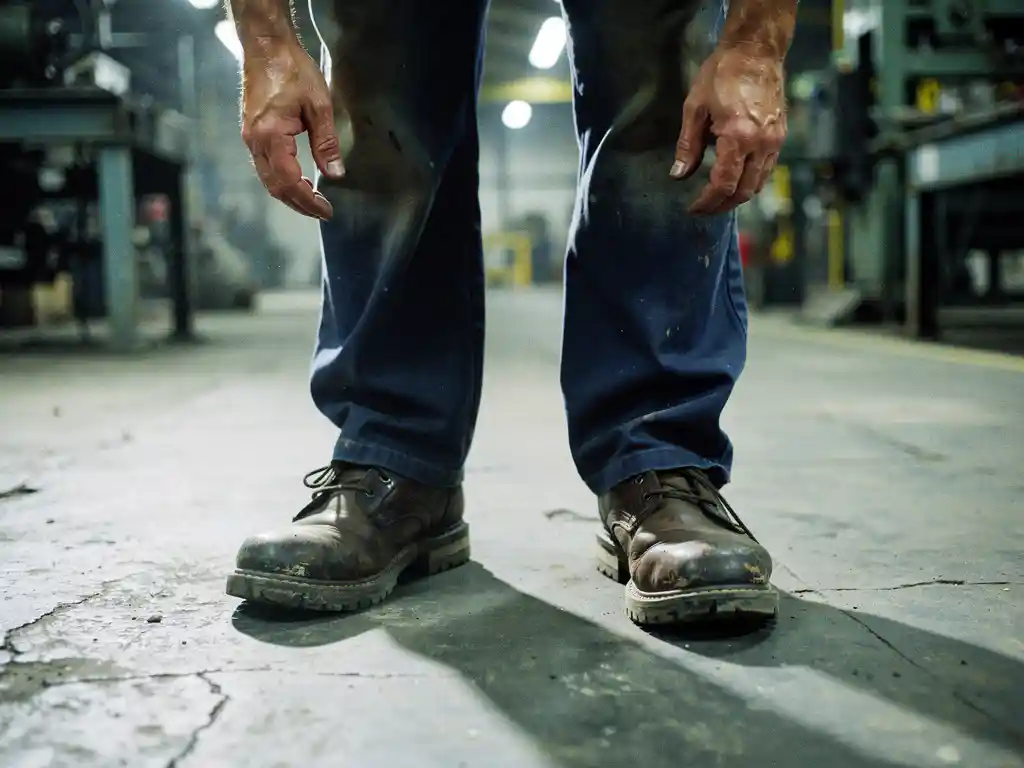
Hard floors increase discomfort because they offer no give, forcing your body to absorb all the impact of standing rather than sharing it with the surface beneath you. Over time, this constant pressure compresses joints, restricts circulation, and tires out the muscles in your legs, feet, and lower back. The harder and less forgiving the surface, the faster fatigue sets in. Below, we break down exactly what is happening to your body, which surfaces are the worst offenders, and what you can do about it.
What happens to your body when you stand on hard floors?
When you stand on a hard floor, your muscles, joints, and circulatory system all come under increased stress. Because the surface does not absorb any of the force from your body weight, your legs and feet take on the full load. Muscles tighten to stabilize your posture, blood flow slows in your lower limbs, and pressure builds in your joints from the ankles all the way up to the lower back.
One of the first things that happens is that the small stabilizing muscles in your feet and calves begin working overtime. These muscles are not designed for sustained static effort. When they are held under constant tension without relief, they fatigue quickly. That burning or aching sensation you feel after a long shift on a concrete floor is those muscles telling you they have reached their limit.
At the same time, standing still on a hard surface slows the return of blood from your legs back to your heart. Blood begins to pool in the lower limbs, which contributes to swelling, heaviness, and that dull throbbing feeling in your feet and calves by the end of the day. This is not just uncomfortable. Over time, it can affect overall circulation and contribute to more serious musculoskeletal issues.
Why do hard floors cause more fatigue than soft surfaces?
Hard floors cause more fatigue than soft surfaces because they force your body to do all the work of shock absorption. A softer surface compresses slightly underfoot, which reduces the impact on your joints and allows your muscles to work in shorter, more manageable bursts. On a hard floor, there is no compression, so your muscles stay contracted for longer and your joints absorb repeated impact without any cushioning.
Think of it this way: walking on grass feels easier than walking on pavement, even if you cover the same distance. The reason is that a forgiving surface reduces the mechanical load on your body with every step. The same principle applies to standing. A surface with even a small amount of give can meaningfully reduce the strain your body experiences over a full working day.
From a workplace ergonomics perspective, this distinction matters a great deal. Workers standing on hard floors for several hours a day are consistently more fatigued at the end of their shifts than those working on cushioned or resilient surfaces. That fatigue does not just affect comfort. It affects concentration, reaction time, and the likelihood of making mistakes, which has real implications for worker safety and productivity.
What types of hard floors are the most uncomfortable?
Concrete is widely considered the most uncomfortable floor surface for prolonged standing. It is completely rigid, has no give whatsoever, and is often cold, which adds to discomfort. Ceramic tile, stone, and polished hardwood are similarly unforgiving. The common thread among the most uncomfortable surfaces is density and rigidity. The harder and denser the material, the less energy it absorbs and the more your body has to compensate.
Concrete floors are especially common in industrial and manufacturing settings, warehouses, and commercial kitchens. These are also environments where workers often stand for long stretches without moving much, which compounds the problem. Standing still on concrete is significantly harder on the body than walking on it, because walking at least keeps blood circulating and shifts the load between different muscle groups.
Tile and stone surfaces are frequent in retail, hospitality, and food service environments. While they may look more polished than concrete, they offer just as little cushioning. Workers in these settings are often on their feet for full eight-hour shifts, making the surface underfoot a direct factor in their daily physical well-being.
Who is most at risk from prolonged hard floor exposure?
Workers who stand for long periods without significant movement are most at risk from prolonged hard floor exposure. This includes people in manufacturing, assembly, retail, food service, healthcare, and warehouse roles. The risk increases with shift length, age, pre-existing joint or circulation conditions, and footwear that provides little support. Anyone spending more than four hours a day on a hard surface should take the risks seriously.
Older workers tend to feel the effects more acutely because joint cartilage naturally thins with age, reducing the body’s built-in shock absorption. People with flat feet or other biomechanical differences also experience hard floors more intensely, since their foot structure already places extra strain on the ankles, knees, and hips.
From an employee wellbeing standpoint, standing fatigue is one of the most commonly underestimated workplace hazards. It rarely causes a single dramatic injury, but it builds up steadily over weeks, months, and years. Chronic lower back pain, plantar fasciitis, varicose veins, and knee problems are all conditions that have strong links to prolonged standing on hard surfaces. Addressing the issue early is far more effective than managing its consequences later.
How does rubber matting reduce hard floor discomfort?
Rubber matting reduces hard floor discomfort by placing a resilient, cushioned layer between your feet and the rigid surface below. When you stand on rubber, the material compresses slightly underfoot, absorbing some of the load that would otherwise go directly into your joints and muscles. This small but consistent reduction in mechanical stress adds up significantly over the course of a working day, reducing fatigue, improving circulation, and easing pressure on the lower back.
Anti-fatigue rubber mats work by encouraging subtle, continuous micro-movements in the muscles of your feet and calves. These small adjustments keep blood flowing more freely and prevent the kind of static muscle tension that leads to soreness and exhaustion. The result is that workers feel noticeably less tired at the end of a shift, even without changing anything else about their environment.
Rubber is also a practical choice because it is durable, non-porous, and easy to clean. Unlike foam alternatives that compress permanently over time, quality rubber matting maintains its cushioning properties through years of heavy use. For industrial and commercial settings where the floor surface cannot be changed, rubber matting is one of the most effective and straightforward improvements you can make for standing fatigue.
What should you look for in a mat to counter hard floor fatigue?
To counter hard floor fatigue effectively, look for a mat that offers genuine cushioning, a stable non-slip base, and the right thickness for your environment. The mat should compress slightly underfoot without feeling unstable, and it should stay firmly in place during use. Beveled edges reduce trip hazards, and a surface texture that provides grip without being abrasive is important for both safety and comfort.
Thickness matters more than most people expect. A mat that is too thin offers little more cushioning than the hard floor itself. For standing workstations, a thickness of around half an inch to three-quarters of an inch tends to strike the right balance between comfort and stability. Thicker is not always better. A surface that is too soft can actually increase the effort required to stand and walk, which defeats the purpose.
Material quality is equally important. Rubber mats made from high-grade compounds hold their shape and cushioning properties far longer than cheaper foam or PVC alternatives. If you are outfitting a workspace where mats will see heavy daily use, investing in durable rubber matting pays off over the long term because you are not replacing them every year.
At LRP Matting, we make anti-fatigue rubber mats from 100% recycled materials, including our proprietary Fiber Reinforced Rubber Compound (FRC®), which gives our mats extra strength and lasting cushioning. Whether you need a standard size or a custom-fit solution for an unusual space, we can help you find the right mat for your floor. Explore our anti-fatigue matting solutions to see what works best for your environment.
Frequently Asked Questions
How long can you stand on a hard floor before it starts causing real damage?
Most ergonomics guidelines suggest that standing on a hard surface for more than two hours continuously begins to place meaningful strain on joints, muscles, and circulation. Four or more hours per day of hard floor standing is widely associated with chronic musculoskeletal issues including plantar fasciitis, lower back pain, and knee problems. The damage is rarely sudden — it accumulates gradually over weeks and months, which is why it is easy to underestimate until the symptoms become persistent.
Can the right footwear alone solve hard floor fatigue, or do I need matting as well?
Supportive footwear helps and should always be part of the equation, but it addresses only one side of the problem. Good shoes cushion the foot from below and provide arch support, but they cannot change the mechanical reality of a rigid surface absorbing zero impact. Combining quality footwear with anti-fatigue matting gives you cushioning from both directions — above and below — which is significantly more effective than either solution on its own.
What is the best way to introduce anti-fatigue matting into an existing workspace without disrupting operations?
The most practical approach is to start with the highest-priority standing zones — workstations where employees spend the most continuous time on their feet — and expand from there. Mats with beveled edges and non-slip bases can be placed and repositioned without any floor modification, making them easy to trial before committing to a full rollout. Most workplaces see an immediate reduction in end-of-shift fatigue complaints within the first week of use, which makes the case for broader adoption straightforward.
Are there situations where anti-fatigue matting is not suitable or could create a safety risk?
Matting is not appropriate in areas where heavy wheeled equipment such as forklifts or pallet trucks operate regularly, as mats can bunch, shift, or create uneven surfaces that interfere with vehicle stability. High-traffic walkways where people are moving quickly can also be a concern if mats are not properly secured or lack beveled edges. In these cases, the right solution is to choose matting specifically rated for those environments or to limit mat placement to dedicated standing zones rather than general thoroughfares.
How do I know when an anti-fatigue mat needs to be replaced?
The most reliable sign is a loss of cushioning — if the mat no longer compresses noticeably underfoot and feels closer to standing on the hard floor itself, it has reached the end of its useful life. Visible surface cracking, permanent indentations, curling edges, or a base that no longer grips the floor are also clear indicators. High-quality rubber mats typically outlast foam and PVC alternatives significantly, but any mat that has lost its resilience is no longer doing its job and should be replaced.
Does taking regular breaks from standing actually make a meaningful difference on hard floors?
Yes — movement breaks are one of the most effective and zero-cost interventions available. Even a two-minute walk every 30 to 45 minutes helps restore circulation, releases static muscle tension, and gives compressed joints a brief period of relief. Sit-stand workstations that allow workers to alternate between positions throughout the day are even more effective. Matting and movement breaks work best together: the mat reduces baseline fatigue during standing periods, while regular movement prevents the buildup of the circulatory and muscular strain that accumulates during prolonged static postures.
Can hard floor fatigue contribute to workplace injuries beyond just soreness and tiredness?
It can, and this is one of the most important reasons to address it proactively. Fatigue impairs concentration, slows reaction times, and reduces the physical coordination needed to avoid slips, trips, and handling errors. In industrial and commercial environments, a tired worker is statistically more likely to be involved in an incident. Beyond acute injury risk, the long-term musculoskeletal conditions linked to hard floor standing — including chronic back pain, plantar fasciitis, and varicose veins — can result in extended absences and long-term disability, making prevention a sound investment for both employers and employees.
Related Articles
- What causes premature floor failure?
- What role does flooring play in preventing musculoskeletal strain?
- How often should commercial floors be maintained?
- What is the best flooring for an indoor training facility?
- What flooring works best in a high-moisture veterinary environment?
- What type of flooring holds up best in a high-traffic athletic venue?
- What is the best way to cover an uneven barn floor?
- Why is my horse stiff after being in the stall overnight?
- What type of floor is easiest to keep clean in a horse barn?
- What type of flooring is best for a horse recovery stall?