
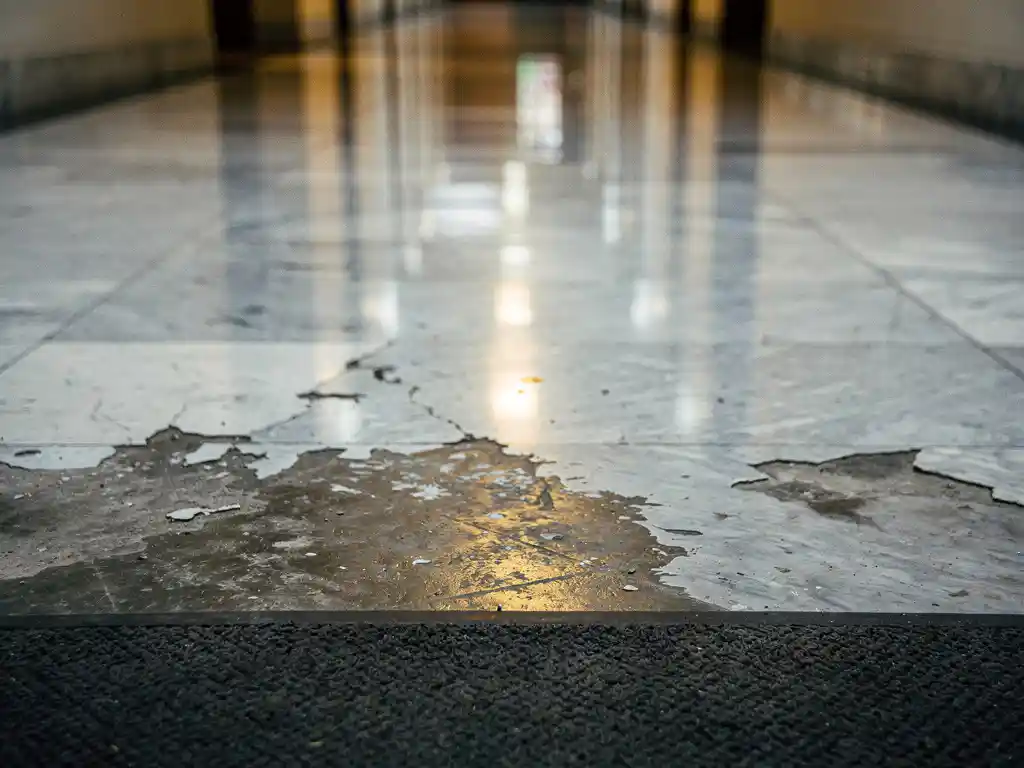
Floor surfaces become polished over time because repeated foot traffic, friction, and abrasion gradually wear down the microscopic texture on the surface, making it smoother and more reflective. This process happens naturally on hard flooring materials like concrete, stone, and tile. How quickly it happens depends on the type of flooring, the volume of traffic, and the environment it sits in. Below, we break down the causes, the risks, and what you can do about it.
What causes floor surfaces to become polished over time?
Floor surfaces become polished through a process called abrasive wear. Every time a shoe, boot, wheel, or piece of equipment moves across a floor, it removes tiny amounts of surface material. Over time, this smooths out the microscopic peaks and valleys that give the floor its grip and texture. The result is a surface that looks shiny but performs poorly under load.
This wear is not always visible in the early stages. Floors can lose meaningful amounts of surface texture before the change becomes obvious to the eye. The rate of polishing depends on the hardness of the flooring material, the type of traffic it receives, and whether any contaminants like water, oil, or fine dust are present. Wet or oily conditions accelerate the process significantly because they act as lubricants, reducing friction and making abrasion more effective at smoothing the surface.
Which floor materials are most prone to polishing?
Softer or finer-grained materials polish the fastest. Polished concrete, natural stone like marble and limestone, ceramic tile, and terrazzo are among the most prone to surface polishing. These materials may start with a textured or matte finish, but under sustained traffic, they develop a glassy appearance over time.
Concrete is particularly worth highlighting in industrial and commercial settings. Uncoated concrete is porous and relatively rough when new, which gives it decent grip. But as traffic compacts and smooths the surface, floor durability drops and slip resistance decreases. Epoxy-coated floors can follow a similar pattern once the top layer wears thin. Softer natural stones like marble polish especially quickly because they are not hard enough to resist the constant friction from foot traffic and cleaning equipment.
Why does a polished floor become more slippery?
A polished floor becomes more slippery because its surface texture has been reduced. Grip between a shoe sole and a floor depends on microscopic contact points. When those points are worn flat, there is less mechanical resistance to sliding. The floor offers less friction, and the risk of slipping goes up, especially when the surface is wet or contaminated with dust or oil.
This is not just a comfort issue. In industrial and commercial environments, slippery floors are a direct workplace safety concern. The same floor that felt firm and safe when it was installed can become genuinely hazardous after months or years of heavy use. Surface performance degrades gradually, which means the change often goes unnoticed until an incident occurs. Regular floor inspections and slip resistance testing are practical ways to catch the problem before it becomes a safety issue.
What environments cause floors to polish the fastest?
High-traffic industrial and commercial environments cause floors to polish the fastest. Warehouses, manufacturing plants, food processing facilities, retail stores, and gyms all generate the kind of sustained, repetitive traffic that accelerates surface wear. The combination of heavy loads, wheeled equipment, and foot traffic creates conditions where floor wear happens quickly.
Wet environments make things worse. In food production or agricultural settings, floors are regularly exposed to water, cleaning chemicals, and organic material. These substances reduce friction and make the abrasive wear process more effective. Fine particles like metal shavings, concrete dust, or grit act like sandpaper underfoot, grinding down the floor surface with every pass. Assembly lines and loading docks are particularly vulnerable because they combine heavy equipment, repeated movement patterns, and often some level of contamination.
How can rubber matting prevent floor surfaces from polishing?
Rubber matting prevents floor polishing by creating a protective barrier between the floor surface and the traffic moving across it. The mat absorbs the friction and abrasion that would otherwise act directly on the floor. This reduces wear on the underlying surface and extends the working life of the floor significantly.
Beyond protection, rubber mats add an independent layer of slip resistance. Even if the floor beneath has already begun to polish, a well-chosen mat restores grip and reduces the risk of slipping. Rubber is naturally non-porous, so it does not absorb water or oil, and it maintains its surface texture even under heavy use. In high-traffic industrial zones, placing mats at entry points, workstations, and along travel paths is one of the most practical and cost-effective ways to manage floor wear. Concrete floor protection is especially relevant in manufacturing and warehouse settings, where the floor takes a significant amount of punishment every day.
When should you replace flooring that has already polished?
You should consider replacing or resurfacing polished flooring when it no longer meets the slip resistance requirements for its environment, when repairs are no longer cost-effective, or when the surface has worn to the point where structural integrity is affected. For most commercial and industrial floors, this decision is driven by safety standards rather than appearance alone.
Before replacement, it is worth exploring resurfacing options. Concrete floors can be ground back, recoated, or treated with anti-slip additives to restore surface performance. Tiles can be replaced individually. In many cases, adding permanent rubber matting in the most affected areas can extend the usable life of the existing floor while the replacement decision is being made. If the polishing is localized to specific zones, targeted solutions often make more sense than a full floor replacement. A full replacement becomes the right call when the floor has worn unevenly, when resurfacing costs approach replacement costs, or when the floor can no longer be made safe through surface treatments alone.
At LRP Matting, we offer a wide range of industrial rubber matting solutions designed to protect floors, reduce wear, and improve safety in demanding environments. All our mats are made from 100% recycled materials, including our proprietary Fiber Reinforced Rubber Compound (FRC®), which delivers durability that stands up to the heaviest industrial use. If your floors are showing signs of wear, we are happy to help you find the right matting solution for your space.
Frequently Asked Questions
How do I know if my floor has already lost too much slip resistance to be safe?
The most reliable way is to conduct a formal slip resistance test using a pendulum test or a portable skid resistance tester, which measures the floor’s coefficient of friction against established safety benchmarks. Visually, warning signs include a noticeably shiny or glassy surface, visible worn paths along high-traffic routes, and a surface that feels slick underfoot even when dry. Don’t rely on appearance alone — a floor can look acceptable while already falling below safe friction thresholds, especially in wet or oily conditions.
Can I restore slip resistance to a polished floor without replacing it entirely?
Yes, in many cases resurfacing is a viable and cost-effective alternative to full replacement. Options include mechanical grinding to expose fresh aggregate, applying anti-slip coatings or epoxy overlays with textured additives, or using acid etching on concrete to reopen the surface pores. For a quicker interim solution, installing rubber matting over the affected areas immediately restores grip while you plan a longer-term fix.
What type of rubber matting works best for industrial floors that are already showing wear?
For industrial environments with heavy foot traffic, wheeled equipment, or wet conditions, look for mats with a raised stud or open-grid surface pattern, as these channel liquids away and maintain grip even under contamination. Thickness matters too — mats of at least 10–12mm provide better cushioning and durability under heavy loads. Mats made from reinforced rubber compounds, like FRC®, are especially well-suited because they resist compression and deformation over years of heavy use.
How often should industrial floors be inspected for surface wear?
In high-traffic industrial settings, a visual inspection should be carried out at least monthly, with a formal slip resistance assessment conducted every six to twelve months, or immediately following any slip or near-miss incident. Pay particular attention to areas with fixed movement patterns, such as loading dock approaches, workstation zones, and entry points, as these tend to polish significantly faster than the surrounding floor. Keeping a simple inspection log helps track wear progression over time and supports compliance with workplace safety regulations.
Are there specific cleaning practices that slow down floor polishing?
Yes — the cleaning equipment and chemicals you use can either accelerate or slow surface wear. Avoid rotary scrubbers with abrasive pads on softer floor materials like marble or ceramic tile, as these actively contribute to polishing. Use pH-neutral cleaners where possible, since acidic or highly alkaline chemicals can degrade surface coatings and soften certain stone floors. Removing grit and fine particles promptly is particularly important, as dry particulate contamination acts like sandpaper underfoot and speeds up abrasive wear considerably.
Do rubber mats themselves wear out and lose grip over time?
Quality rubber mats do experience surface wear, but at a much slower rate than hard flooring materials, and they are far easier and cheaper to replace than an entire floor. The key is to inspect mats regularly for surface smoothing, cracking, or compression — a mat that has lost its surface texture or has become permanently compressed underfoot should be replaced. Mats made from reinforced rubber compounds tend to have a significantly longer service life than standard recycled rubber mats, making them a better long-term investment in demanding environments.
Is floor polishing a concern in outdoor or semi-outdoor environments as well?
Absolutely — outdoor and semi-outdoor surfaces like concrete ramps, loading bay aprons, and covered walkways are just as susceptible to polishing, and the risk is often higher because these areas are regularly exposed to rain, standing water, and tracked-in contaminants. Smooth, polished outdoor concrete in wet conditions can reach dangerously low friction levels very quickly. Anti-slip surface treatments, drainage-optimized matting, and regular grit-blasting or scarifying of outdoor concrete are all practical measures to maintain safe grip levels in these environments.
Related Articles
- What makes a floor safe?
- What is the best flooring for an indoor training facility?
- How do you choose flooring for a professional sports locker room?
- What is the difference between interlocking and straight edge stall mats?
- How do you prevent floor damage from forklifts in a warehouse?
- How do you choose the right anti-fatigue mat thickness for a factory?
- How do you keep a horse stall floor from getting slippery when wet?
- How do you make a horse stall more comfortable for an older horse?
- What type of floor is easiest to keep clean in a horse barn?
- What is the most comfortable floor surface for a horse to stand on?