

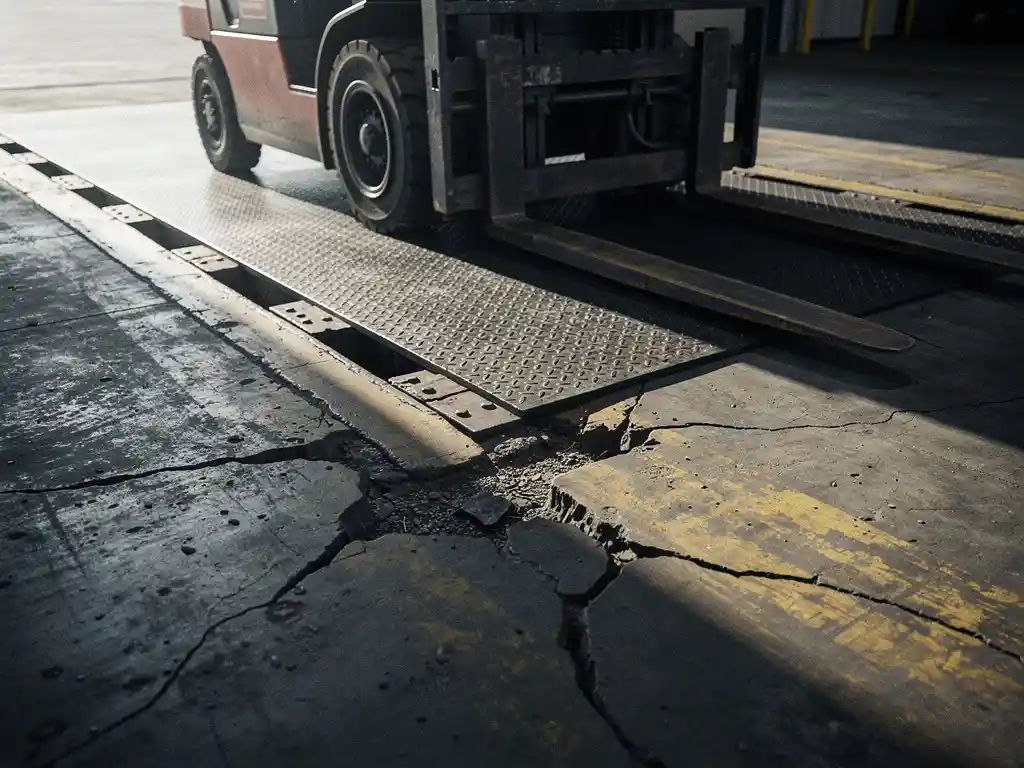
Loading docks significantly shorten floor lifespan by exposing surfaces to a combination of heavy mechanical stress, constant traffic, and moisture infiltration that most flooring materials simply aren’t built to handle long-term. Without proper protection, a loading dock floor can deteriorate in just a few years rather than lasting a decade or more. Below, we break down exactly what causes the damage and what you can do to slow it down.
What types of damage do loading docks cause to floors?
Loading docks cause four main types of floor damage: surface abrasion from repeated wheel traffic, impact damage from dropped loads and pallet jacks, chemical degradation from fuel and hydraulic fluid spills, and moisture-related deterioration from rain, snow, and condensation. Each of these forces acts on the floor constantly, and together they accelerate wear far faster than any single factor alone.
Surface abrasion is the most visible form of damage. Every time a forklift or pallet jack rolls across the floor, the wheels grind against the surface. Over time, this strips away protective coatings, roughens the concrete, and creates uneven patches that become both a safety hazard and a structural problem. In a busy warehouse, this kind of traffic happens hundreds of times a day.
Impact damage is less obvious but equally serious. When loads are dropped, when dock plates shift, or when heavy pallets are dragged rather than lifted, the floor absorbs the shock directly. Concrete can crack and chip. Epoxy coatings can delaminate. Once the surface layer is compromised, moisture and contaminants get into the substrate and the damage compounds quickly.
Chemical spills add another layer of stress. Forklifts leak oil. Batteries on electric lifts release acid. These substances break down concrete and flooring coatings at a chemical level, causing discoloration, softening, and eventually structural weakness that no amount of cleaning can reverse.
Why do forklift wheels wear out floors so quickly?
Forklift wheels wear out floors quickly because they combine high point-load pressure with repetitive, concentrated traffic patterns. Unlike car tires that distribute weight across a wide contact patch on smooth asphalt, forklift wheels are narrow, hard, and carry enormous loads. This concentrates thousands of pounds of force onto a small surface area, grinding down flooring materials with every pass.
The type of forklift wheel matters too. Polyurethane and hard rubber wheels are the most common in warehouse environments, and both are significantly harder than the concrete beneath them. When these wheels roll over a surface repeatedly, especially in the same spots near dock doors and staging areas, they act almost like a sanding tool, slowly removing material from the floor surface.
The turning motion makes things worse. Forklifts don’t just drive in straight lines. They turn, pivot, and maneuver in tight spaces. Turning under load creates lateral shear forces that are even more damaging than forward rolling. This is why loading dock floors often show the worst wear at turning points and near the dock leveler, where drivers repeatedly spin and reposition.
How does moisture shorten loading dock floor lifespan?
Moisture shortens loading dock floor lifespan by penetrating cracks and pores in the floor surface, causing concrete to expand and contract with temperature changes, weakening adhesive bonds in coated floors, and promoting mold and bacterial growth that degrades both the floor and the surrounding environment. Water is one of the most persistent sources of long-term floor damage in any logistics facility.
Loading docks are particularly vulnerable to moisture because they are transition zones between the outside and inside. Rain, snow, and humidity enter every time a dock door opens. Truck beds bring in water. Forklifts carry wet tires from outdoor areas. This constant moisture exposure means the floor rarely gets a chance to fully dry out.
In cold climates, the freeze-thaw cycle is especially destructive. Water that seeps into small cracks in the concrete expands when it freezes, widening those cracks. When it thaws, the weakened concrete crumbles slightly. Repeat this cycle dozens of times over a winter season and small surface cracks become structural problems. Moisture also accelerates rust in any embedded metal, including rebar and dock leveler anchors, which can cause the concrete around them to spall and fracture.
What’s the difference between a protected and unprotected dock floor?
A protected dock floor has a physical or chemical barrier between the floor surface and the sources of damage, such as rubber matting, epoxy coatings, or reinforced overlays. An unprotected dock floor is bare concrete or a degraded surface that absorbs impact, moisture, and abrasion directly. The practical difference is measured in years of usable floor life and significantly lower maintenance costs.
Unprotected dock floors
Bare concrete at a loading dock is constantly under attack. Without a protective layer, every forklift pass, every spill, and every rain event acts directly on the floor material. Concrete is porous, so moisture and chemicals penetrate easily. Surface coatings like paint or basic sealers offer limited protection and tend to chip and peel under heavy traffic, leaving the floor worse off than bare concrete because the peeling coating creates uneven surfaces and slip risks.
Protected dock floors
A properly protected floor uses materials matched to the specific stresses of the environment. Rubber matting absorbs impact and distributes the load, reducing the point pressure that forklift wheels create. It also acts as a moisture barrier, keeping water from reaching the concrete below. Epoxy and polyurethane coatings seal the concrete against chemical penetration. Reinforced overlays can restore and strengthen floors that are already partially damaged. The right combination depends on the volume of traffic, the types of equipment used, and the local climate.
How long should a loading dock floor last with proper protection?
With proper protection and regular maintenance, a loading dock floor should last 15 to 25 years before requiring major structural repair or replacement. Without protection, the same floor in a busy facility may show significant deterioration within 3 to 7 years. The difference comes down to how well the floor is shielded from the mechanical, chemical, and moisture-related stresses that loading dock environments generate every day.
The actual lifespan depends on several factors: the volume of daily traffic, the weight of loads being moved, the type of equipment used, local weather conditions, and how consistently the floor is maintained and inspected. A distribution center running two shifts with heavy forklifts will wear a floor faster than a smaller operation with lighter equipment and fewer daily cycles.
Routine maintenance extends floor life considerably. Sealing cracks before they spread, cleaning up chemical spills promptly, and replacing worn protective mats or coatings before the underlying floor is exposed all add years to the floor’s functional lifespan. The cost of maintenance is almost always lower than the cost of floor replacement or extended downtime for repairs.
What should you look for in a loading dock rubber mat?
A good loading dock rubber mat should be thick enough to absorb forklift impact, made from dense, non-porous rubber that resists moisture and chemicals, and sized to cover the high-traffic zones without creating trip hazards at the edges. Look for mats with a textured or diamond-plate surface pattern to improve traction, and check that the material is rated for the load weights your equipment generates.
Thickness matters more than most buyers expect. Thinner mats compress quickly under repeated heavy loads and lose their protective and cushioning properties. For loading dock environments, mats in the range of 3/4 inch to 1 inch or more provide meaningful impact absorption and hold their shape under sustained use. Mats made from a fiber-reinforced rubber compound offer additional structural strength, making them more resistant to tearing and permanent deformation under heavy equipment.
Size is another practical consideration. Larger mats mean fewer seams, and seams are where moisture infiltrates, edges curl, and trip hazards develop. Choosing the largest mat that fits your dock area reduces installation complexity and keeps the surface more uniform over time. For irregular or custom-sized dock areas, made-to-measure options eliminate the need to piece together multiple smaller mats.
Finally, look at how the mat handles moisture. A non-porous rubber mat will not absorb water, which means it stays cleaner, dries faster, and doesn’t harbor bacteria or mold. This matters both for warehouse safety and for facilities that operate under food safety or hygiene regulations.
At LRP Matting, we manufacture rubber mats specifically designed for demanding industrial environments like loading docks. Our mats are made from 100% recycled rubber, including options in our proprietary FRC® fiber-reinforced compound for extra strength and durability. We offer both standard and custom sizes, so you can cover your dock floor without awkward seams or gaps. If you’re looking for a practical starting point, our industrial matting solutions cover the full range of heavy-duty applications, from loading docks to manufacturing floors.
Frequently Asked Questions
How often should I inspect my loading dock floor for damage?
Loading dock floors should be inspected at least once a month in high-traffic facilities, and more frequently during winter months when freeze-thaw cycles accelerate concrete damage. During each inspection, look for new cracks, surface spalling, coating delamination, pooling water, and worn or curling mat edges. Catching small issues early — like a hairline crack or a mat that’s starting to compress unevenly — allows you to address them before they become costly structural repairs.
Can I apply an epoxy coating over a loading dock floor that's already damaged?
You can apply epoxy over a damaged floor, but only after proper surface preparation — otherwise the coating will fail quickly. Existing cracks must be filled and ground flush, loose or spalling concrete must be removed, and the surface needs to be mechanically profiled (typically by shot blasting or diamond grinding) to ensure proper adhesion. Applying epoxy over a compromised surface without these steps is one of the most common and costly mistakes facility managers make, as the coating will peel and leave the floor in worse condition than before.
What's the best way to reduce forklift-related floor damage without replacing equipment?
The most effective approach without changing equipment is to combine rubber matting in high-traffic zones with a strict traffic management plan. Place mats at dock doors, staging areas, and common turning points — the spots where forklift wear is most concentrated. Additionally, enforcing slower speeds and discouraging sharp pivot turns under full loads can significantly reduce lateral shear forces on the floor surface. Regularly inspecting and replacing worn forklift wheels also helps, since damaged or flat-spotted wheels create uneven pressure that accelerates floor wear.
Are rubber mats a permanent solution or just a temporary fix for dock floor protection?
High-quality rubber mats are a long-term protective solution, not a temporary patch — provided you choose the right thickness and material for your environment. A properly specified mat made from dense, fiber-reinforced rubber can last 10 years or more under heavy industrial use while continuously protecting the concrete beneath it. They become a temporary fix only when undersized, under-specified mats are used, which compress, tear, or curl prematurely and end up being replaced repeatedly rather than providing lasting protection.
How do I handle chemical spills on a loading dock floor to minimize long-term damage?
Act immediately — the longer oil, hydraulic fluid, or battery acid sits on the floor, the deeper it penetrates and the more damage it causes. Absorb the spill with an industrial-grade absorbent material, then clean the area with a degreaser appropriate for your floor type. For uncoated concrete, follow up with a penetrating concrete sealer on the affected area to close pores that the chemical may have opened. If spills are frequent, adding a chemical-resistant rubber mat or polyurethane coating in those specific zones is a practical long-term preventive measure.
Is it worth investing in floor protection for a loading dock that's already in poor condition?
In most cases, yes — restoring and then protecting a damaged floor is significantly less expensive than full replacement, and it extends the usable life of the existing slab by many years. The key is to address the underlying damage first: fill and stabilize cracks, repair spalled areas, and apply a reinforced overlay if the surface is extensively worn before adding protective matting or coatings. Skipping the restoration step and applying protection directly over a failing floor will only delay the inevitable and waste the investment.
Do loading dock floors require different protection strategies depending on climate?
Yes, climate is one of the most important variables in choosing the right floor protection strategy. In cold climates with frequent freeze-thaw cycles, the priority is sealing the concrete against moisture infiltration and using mats that create a barrier between wet, icy conditions and the floor surface. In humid or coastal environments, mold resistance and non-porous materials become critical. In warmer, drier climates, the focus shifts more toward abrasion resistance and chemical protection, since moisture-related deterioration is less of a concern but UV exposure and temperature fluctuations can still affect coating performance.
Related Articles
- What are the signs employees are experiencing floor related fatigue?
- How do you extend the lifespan of facility floors?
- What should be included in a sports surface safety inspection?
- What are the biggest flooring maintenance mistakes?
- What factors influence animal comfort in housing facilities?
- How often should commercial floors be maintained?
- How do different floor materials affect slip resistance?
- What is the best flooring for an indoor training facility?
- How do you make a workshop floor more comfortable to work on?
- What is the most comfortable floor surface for a horse to stand on?