

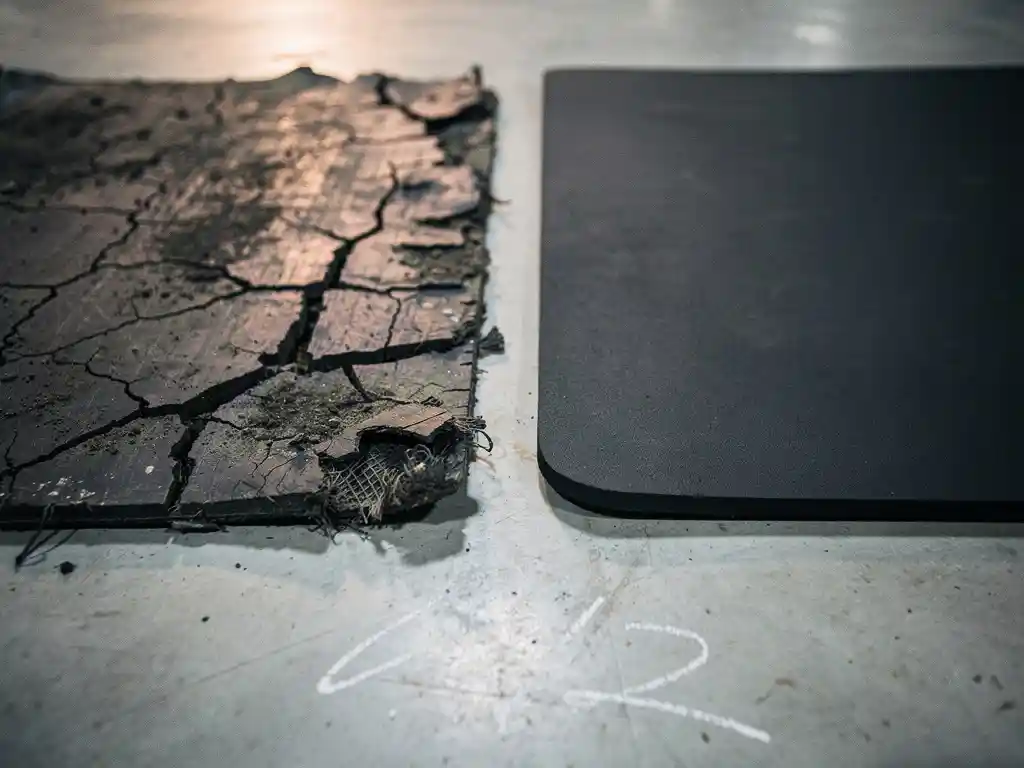
Replace facility flooring when damage is structural, widespread, or creates safety risks that spot repairs cannot fix. Repair is the right call for isolated, surface-level issues on otherwise sound flooring. The deciding factors are the extent of the damage, the age of the floor, the material type, and how demanding the environment is. The sections below walk through each of those factors in practical detail.
What are the signs that facility flooring needs replacing?
Facility flooring needs replacing when damage is no longer isolated, when the surface creates slip or trip hazards that cannot be corrected with a patch, or when the floor has degraded to a point where cleaning and maintenance no longer work. These are signs that the material has reached the end of its useful life, not just a rough patch.
Watch for these specific warning signs:
- Widespread cracking, crumbling, or delamination across large sections of the floor
- Persistent moisture absorption that leads to mold, odor, or soft spots beneath the surface
- Uneven surfaces or raised seams that create trip hazards despite repeated repairs
- Loss of slip resistance that cannot be restored through cleaning or treatment
- Structural damage to the subfloor caused by a failing top layer
- Repeated repairs to the same area within a short period
In facility management, the practical rule is straightforward: if you are spending more time managing the floor than using the facility, replacement is overdue. Cosmetic wear is one thing. Safety-compromising deterioration is another.
When is repairing facility flooring a viable option?
Repairing facility flooring is a viable option when damage is localized, the surrounding material is still structurally sound, and the repair will hold up under the same conditions that caused the original damage. A good repair extends the floor’s life without the cost or downtime of full replacement.
Repair works well in these situations:
- A small section of flooring was damaged by a one-time incident, such as a dropped tool or chemical spill
- A single mat or tile in a modular system needs swapping out
- Edge lifting or minor seam separation can be re-bonded without replacing the whole surface
- The floor is relatively new, and the damage is clearly isolated
The key question to ask is whether the repair will last. If the same area keeps failing, or if the repair material cannot match the performance of the original surface, you are delaying an inevitable replacement and likely spending more in the long run.
What’s the difference between repairing and replacing rubber matting?
Repairing rubber matting means fixing or patching a specific damaged section while leaving the rest of the mat or flooring system in place. Replacing means removing the existing matting entirely and installing new material. The difference matters because rubber matting, unlike many hard flooring types, is often modular, which makes targeted replacement of individual pieces practical and cost-effective.
With rubber matting specifically, the repair-or-replace decision is often simpler than with other materials. Because many rubber floor systems use interlocking tiles or individual mats rather than a continuous bonded surface, a single damaged piece can often be swapped out without disturbing the rest of the installation. This is one of the practical advantages of rubber matting in high-traffic facility environments.
Full replacement of rubber matting makes sense when the material has hardened, lost its surface texture, or when the thickness has worn down to a point where it no longer provides the cushioning or slip resistance it was designed for. Age and cumulative wear, not just visible damage, drive that decision.
How does flooring material affect the repair-or-replace decision?
Flooring material directly determines how repairable a floor is, how long it lasts under stress, and how quickly deterioration spreads. Different materials fail in different ways, and understanding those failure modes helps you make a more informed floor maintenance decision.
Here is how common facility flooring materials compare:
- Vinyl and PVC flooring tends to crack, peel, or lift at the edges over time. It can absorb moisture through seams, making subfloor damage a risk. Repairs are possible but often cosmetically obvious and short-lived in high-traffic areas.
- Epoxy coatings chip and delaminate under heavy point loads or thermal cycling. Patching is possible, but the patched area rarely matches the original finish or performance.
- Concrete can be ground, patched, or recoated, but surface treatments wear away and the process is disruptive and labor-intensive.
- Rubber matting is non-porous, so it does not absorb moisture or harbor bacteria the way porous materials do. It resists cracking under temperature extremes and, in modular formats, allows individual sections to be replaced without pulling up an entire floor.
In preventive maintenance planning, material choice affects not just initial cost but the frequency and complexity of future floor maintenance. Materials that are easier to repair or replace in sections reduce both downtime and long-term cost.
Which facility environments most often require full flooring replacement?
Facilities with heavy machinery, chemical exposure, extreme temperatures, or constant moisture are the environments where full flooring replacement is most common. These conditions accelerate wear beyond what most repair solutions can address, and the safety stakes are higher when the floor fails.
Environments that regularly drive full replacement decisions include:
- Manufacturing and assembly areas where heavy equipment, dropped loads, and constant foot traffic degrade flooring quickly
- Food processing and commercial kitchens where moisture, grease, and cleaning chemicals break down many flooring materials faster than expected
- Warehouses and loading docks where forklift traffic creates concentrated point loads that standard flooring cannot sustain long-term
- Agricultural facilities such as dairy barns and livestock housing, where urine, manure, and constant animal movement create highly corrosive conditions
- Gyms and fitness centers where surface texture and impact absorption degrade with heavy use, reducing both safety and comfort
In these environments, preventive maintenance programs should include scheduled flooring assessments so that replacement happens on a planned timeline rather than in response to an incident.
How long should quality rubber facility flooring last before replacement?
Quality rubber facility flooring in a well-maintained commercial or industrial environment typically lasts between 10 and 20 years before replacement is warranted. The actual lifespan depends on the quality of the rubber compound, the intensity of use, the type of environment, and how consistently the floor is cleaned and maintained.
Rubber flooring made from high-grade or fiber-reinforced compounds tends to outlast standard rubber products because the material resists compression, tearing, and surface degradation more effectively. In lighter commercial applications, a well-made rubber floor can exceed 20 years with proper care. In heavy industrial or agricultural environments, realistic expectations are closer to 10 to 15 years.
Signs that replacement is approaching, even before visible failure, include:
- Noticeable reduction in surface texture and grip
- Compression set, where the mat no longer springs back after load is removed
- Stiffening or brittleness in cold conditions
- Difficulty cleaning to an acceptable hygiene standard
Incorporating flooring into your facility’s preventive maintenance schedule, with annual inspections and documented condition assessments, is the most effective way to catch these signs early and plan replacement before it becomes urgent. At LRP Matting, we manufacture rubber matting built to perform over the long term, and we can help you identify the right product for your specific environment. Explore our industrial rubber matting solutions to find options suited to your facility’s demands.
Frequently Asked Questions
How do I calculate whether repairing or replacing my facility flooring is more cost-effective?
A useful rule of thumb is the 50% rule: if the cost of repairs exceeds 50% of the cost of full replacement, replacement is almost always the better financial decision. Factor in not just the material and labor costs, but also the cumulative downtime from repeated repairs, the risk of a safety incident on a deteriorating floor, and whether a new floor would qualify for a longer warranty. A single replacement that lasts 15 years will nearly always outperform five rounds of patching over the same period.
Can I install new rubber matting directly over existing damaged flooring?
In some cases, yes — but only if the existing subfloor is structurally sound, level, and dry. Laying new matting over a damaged or uneven surface can trap moisture, create instability, and accelerate wear on the new material from below. If the existing floor has soft spots, active moisture issues, or significant unevenness, those problems must be addressed before any new flooring is installed. Modular rubber tile systems are more forgiving of minor subfloor imperfections than bonded sheet rubber, but a proper subfloor assessment should always come first.
What are the most common mistakes facility managers make when deciding between repair and replacement?
The most common mistake is treating repair as the default option simply because it has a lower upfront cost, without accounting for how frequently the same area is being fixed or how much staff time is being spent managing the problem. Another frequent error is delaying replacement until a safety incident occurs, at which point the cost — financial and otherwise — is far higher than a planned replacement would have been. Documenting repair history by zone and reviewing it during annual inspections is the most reliable way to spot when a repair cycle has become a replacement that’s overdue.
How often should facility flooring be formally inspected, and what should an inspection cover?
Formal flooring inspections should be conducted at least once a year in standard commercial environments, and every six months in high-demand settings like manufacturing floors, food processing areas, or agricultural facilities. A thorough inspection should document surface texture and grip levels, check for soft spots or subfloor movement, assess seam and edge integrity, note any areas that have been repeatedly repaired, and flag zones where cleaning standards are becoming harder to maintain. A written condition report with photos gives you a baseline for tracking deterioration over time and supports more confident replacement planning.
Does the type of rubber matting compound matter when planning for long-term durability?
Yes, significantly. Standard recycled rubber compounds offer solid performance in general-purpose applications, but high-grade or fiber-reinforced rubber compounds resist compression set, surface abrasion, and chemical degradation more effectively — which directly translates to a longer service life and fewer replacement cycles. For environments involving chemical exposure, extreme temperatures, or heavy concentrated loads, specifying the right compound from the outset is more cost-effective than replacing a lower-grade product ahead of schedule. Consulting with your matting supplier about the specific demands of your environment before purchasing is the best way to avoid a mismatch between product and application.
What should I do if different zones of my facility have flooring at different stages of wear?
Zone-by-zone replacement is a practical and budget-friendly approach that most facility managers can implement without a full facility shutdown. Prioritize zones based on safety risk first — areas with active slip or trip hazards should be addressed immediately regardless of budget cycles. Lower-risk zones showing early wear can be scheduled for replacement in the next planned maintenance window. Keeping a condition map of your facility’s flooring, updated after each inspection, makes it straightforward to sequence replacements logically and allocate maintenance budgets more accurately year over year.
Are there any interim measures I can take to extend flooring life while planning for replacement?
Yes — several interim measures can buy time without masking underlying problems. Anti-slip treatments or coatings can temporarily restore grip on surfaces that have lost texture, though they require reapplication and are not a permanent fix. In modular rubber systems, rotating or flipping mats in high-traffic zones can distribute wear more evenly across the installation. Placing additional matting over isolated problem areas can protect staff while replacement is being planned and budgeted. The key is to treat these as short-term risk management steps, not substitutes for a replacement that has already been identified as necessary.
Related Articles
- How do forklifts damage facility floors?
- How do workplace surfaces affect employee wellbeing?
- What are the signs employees are experiencing floor related fatigue?
- How often should commercial floors be maintained?
- Why do wet floors become dangerous?
- How do you know when a horse trailer floor needs replacing?
- What thickness of rubber mat is best for a horse trailer floor?
- What is the best flooring for a sports facility?
- How do you set up a new horse stall from scratch?
- How do you insulate a horse stall floor in winter?